Spine Surgery
Disc Replacement Surgery
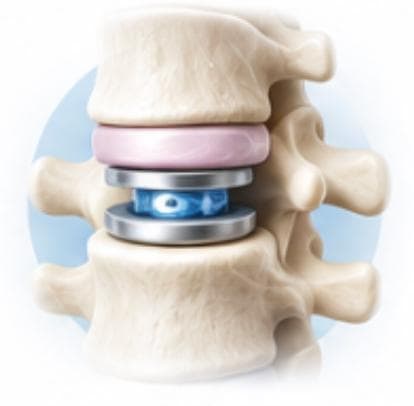
Disc replacement surgery is an alternative to spinal fusion for selected patients, where a damaged disc is replaced with an artificial disc designed to preserve motion at the treated spinal level.
How It's Performed
The damaged disc is removed and replaced with an artificial disc implant designed to maintain movement at that spinal segment, unlike fusion which joins the vertebrae together permanently.
Conditions Treated
- — Degenerative disc disease
- — Selected single- or two-level disc herniations
- — Chronic discogenic back or neck pain unresponsive to conservative care
Benefits
- — Preserves natural spinal motion
- — Alternative to fusion in suitable candidates
- — Aims to reduce stress on adjacent spinal levels
Recovery
Recovery involves gradual mobilisation and a structured physiotherapy programme, with many patients returning to routine activity over several weeks, depending on the individual case.
Is This Right For You?
Not every patient with degenerative disc disease or a related condition needs disc replacement surgery. Dr. Nirmal Patil, MS (Ortho) reviews your symptoms, clinical examination, and imaging to confirm whether this is the right approach for you, or whether conservative treatment is more appropriate.
Risks & Considerations
As with any surgical procedure, disc replacement surgery carries risks, which can include infection, bleeding, and the possibility that symptoms do not fully resolve. These risks, along with the alternatives, are discussed in detail during consultation before any decision to proceed.
Frequently Asked Questions
What is disc replacement surgery?
It is a procedure where a damaged spinal disc is removed and replaced with an artificial disc implant, designed to preserve motion at that spinal level rather than fusing it.
What's the difference between disc replacement and spinal fusion?
Fusion joins two vertebrae together permanently, eliminating motion at that level, while disc replacement aims to preserve natural movement — the right choice depends on your specific condition.
Am I a candidate for disc replacement surgery?
Candidacy depends on factors such as the location and extent of disc damage, spinal alignment, and bone quality. Your surgeon will assess this with a clinical examination and imaging.
How long do artificial disc implants last?
Modern disc implants are designed for long-term use, though longevity varies with individual factors — your surgeon can discuss expectations specific to your case.
Is disc replacement surgery safe?
As with any spine surgery, there are risks, which your surgeon will discuss in detail based on your specific condition and overall health before any decision to proceed.
Discuss your case with Dr. Nirmal Patil, MS (Ortho)
Every case is different. Book a consultation to review your symptoms and imaging.