Spine Surgery
Endoscopic Discectomy
Endoscopic discectomy is a minimally invasive procedure that uses a small endoscope to remove the portion of a herniated disc pressing on a spinal nerve, relieving nerve compression through a very small incision.
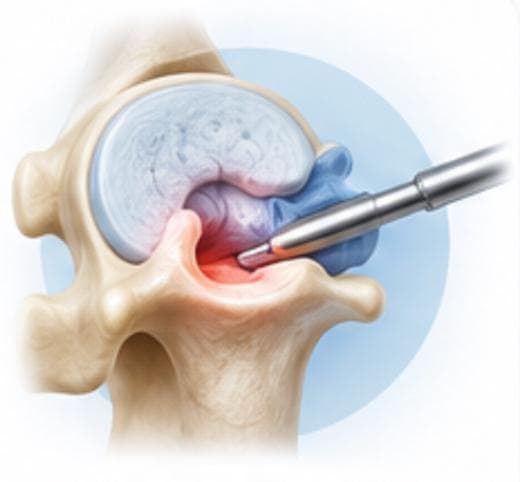
How It's Performed
Using imaging guidance, the surgeon introduces an endoscope through a small incision to directly visualise the herniated disc material and carefully remove the portion compressing the nerve, preserving the healthy remainder of the disc.
Conditions Treated
- — Herniated or slipped disc
- — Sciatica caused by disc herniation
- — Nerve root compression
- — Persistent radiating leg or arm pain from disc herniation
Benefits
- — Very small incision
- — Minimal disruption to surrounding muscle
- — Often performed as day care or short-stay surgery
- — Targeted removal of only the problematic disc tissue
Recovery
Many patients are able to walk soon after the procedure, with a gradual return to routine activities over the following weeks as guided by the surgeon.
Is This Right For You?
Not every patient with herniated or slipped disc or a related condition needs endoscopic discectomy. Dr. Nirmal Patil, MS (Ortho) reviews your symptoms, clinical examination, and imaging to confirm whether this is the right approach for you, or whether conservative treatment is more appropriate.
Risks & Considerations
As with any surgical procedure, endoscopic discectomy carries risks, which can include infection, bleeding, and the possibility that symptoms do not fully resolve. These risks, along with the alternatives, are discussed in detail during consultation before any decision to proceed.
Frequently Asked Questions
What is endoscopic discectomy?
It is a minimally invasive procedure that uses a small endoscope inserted through a tiny incision to remove the portion of a herniated disc compressing a spinal nerve.
How is endoscopic discectomy different from microdiscectomy?
Both target the same problem — a herniated disc pressing on a nerve — but endoscopic discectomy uses an even smaller incision and a video endoscope, while microdiscectomy uses a surgical microscope through a slightly larger incision.
Who needs an endoscopic discectomy?
It's considered for patients with a confirmed disc herniation causing sciatica or radiating leg or arm pain that hasn't improved with conservative treatment such as medication and physiotherapy.
Is endoscopic discectomy a day-care surgery?
It is often performed as a day-care or short-stay procedure, though this depends on the individual case and the surgeon's assessment.
Can a disc herniation come back after discectomy?
Recurrent herniation is possible, though relatively uncommon. Following post-operative activity guidance can help reduce this risk.
Discuss your case with Dr. Nirmal Patil, MS (Ortho)
Every case is different. Book a consultation to review your symptoms and imaging.