Spine Surgery
MIS-TLIF (Minimally Invasive Spinal Fusion)
MIS-TLIF (minimally invasive transforaminal lumbar interbody fusion) is a keyhole spinal fusion technique used to stabilise the spine and relieve nerve compression in select degenerative or unstable lumbar spine conditions.
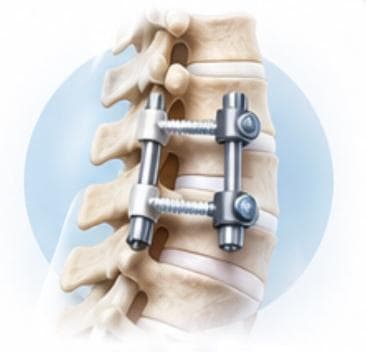
How It's Performed
Working through small incisions and using imaging guidance, the surgeon removes the source of nerve compression, places an interbody spacer to restore disc height, and secures the segment with screws and rods to achieve fusion over time.
Conditions Treated
- — Spondylolisthesis
- — Degenerative disc disease with instability
- — Selected cases of recurrent disc herniation
- — Lumbar spinal instability
Benefits
- — Smaller incisions than open fusion surgery
- — Reduced muscle disruption
- — Aims for a stable, pain-free spine at the treated level
- — Structured recovery pathway
Recovery
Recovery involves early mobilisation followed by a structured rehabilitation programme, with bone fusion occurring gradually over months as guided by the surgeon's follow-up imaging.
Is This Right For You?
Not every patient with spondylolisthesis or a related condition needs mis-tlif (minimally invasive spinal fusion). Dr. Nirmal Patil, MS (Ortho) reviews your symptoms, clinical examination, and imaging to confirm whether this is the right approach for you, or whether conservative treatment is more appropriate.
Risks & Considerations
As with any surgical procedure, mis-tlif (minimally invasive spinal fusion) carries risks, which can include infection, bleeding, and the possibility that symptoms do not fully resolve. These risks, along with the alternatives, are discussed in detail during consultation before any decision to proceed.
Frequently Asked Questions
What is MIS-TLIF surgery?
It stands for minimally invasive transforaminal lumbar interbody fusion — a keyhole technique that removes the source of nerve compression and fuses a spinal segment using screws, rods, and an interbody spacer.
Who needs spinal fusion surgery?
Fusion is generally considered for conditions involving spinal instability, such as spondylolisthesis, or when decompression alone would leave the spine unstable — your surgeon will assess whether this applies to you.
How long does it take for spinal fusion to heal?
Bone fusion typically develops gradually over several months, monitored through follow-up visits and imaging, even though initial recovery and return to activity often happens sooner.
Is MIS-TLIF safer than open spinal fusion?
The minimally invasive approach generally involves smaller incisions and less muscle disruption than open fusion, which may reduce blood loss and support faster initial recovery in suitable candidates — but it carries the same general surgical risks as any spine surgery.
Will I lose flexibility after spinal fusion?
Fusion eliminates motion at the treated spinal segment, but adjacent segments continue to move — most patients don't notice a significant change in overall flexibility for day-to-day activities.
Discuss your case with Dr. Nirmal Patil, MS (Ortho)
Every case is different. Book a consultation to review your symptoms and imaging.